Bow Bass Break Here We Go Again
The bow can be such a mysterious thing on the double bass, particularly when you lot're starting out.
To me, the left mitt seems so much more objective:
- You're either in tune or you're out of tune.
- You're on first finger, second finger, or 4th finger.
- Yous're on the Yard string, D string, A string, or East string.
The bow is more of a musical paintbrush, and agreement the mechanics of drawing a total, resonant sound out of the bass is a night magic in many ways.
If yous're a beginner, have eye! Professionals revisit the fundamentals of bowing nearly every solar day.
Yep, information technology'southward definitely a journey from full beginner to bow fluency, but if you approach it the right way and practice these fundamentals consistently, you'll definitely brand progress.
All of the information in this post and the accompanying video can be found in this PDF guide. I hope you observe it helpful!

Your #1 Obstacle in Bowing
What strops most beginners dead in their tracks is tension. Information technology's and then easy to let tension creep into some function of your torso when bowing, and diagnosing and solving this can quite challenging.
With all that in mind, hither's how I like to approach bowing on the double bass in terms of both mindset and actual step-by-step exercises.
On final word earlier I dig into the topic: while I teach and play both French and German bow, I'm primarily a French Bowie player. I'm also writing this during the coronavirus pandemic, and so I'm stuck at home without easy access to a German language bow for sit-in purposes.
Everything I'g laying out here applies to both French and German language bow, and I've linked upwardly to some excellent German bow-specific resource at the stop of this post.
Laying the foundation earlier picking upwardly the bow
Thinking about the bow and how it interacts with your torso and the instrument to produce tone is perhaps the most important aspect of developing your bow technique.
It doesn't matter what you lot practice in terms of exercises or hours on the instrument if you're squeezing, forcing, or globe-trotting all over the place. In fact, you lot're liable to cause all kinds of issues that are going to exist super-annoying to prepare in the future!
Here's a fundamental concept to keep in mind, and it'due south one that I've heard many times from the amazing bass teacher Paul Ellison:
Your hands should look like your hands.
Paul Ellison
What does that mean, exactly? Well, take a look at how your hands look in everyday life.
Better all the same, stand up up and let your artillery fall naturally to your sides. Take a look at how your fingers and thumb hand naturally.
This is how your hand should look and feel when playing both French and German language bow.

Now bring your correct hand up, just beneath your sternum. Experiment with rotating your forearm and detect how your hand retains its shape.
We're laying the foundation for quality bowing, so this is all important, and you'll desire to practice this every day until it'southward automatic.
Now, pretend that you lot're holding a frisbee in your right mitt. If you've really got a frisbee, you tin can definitely try this with it, but you might desire to go outside and so that you don't interruption anything!

Y'all're going to throw that imaginary (or existent) frisbee to your right. Go through this motion, and observe how your body moves.

Notice that you lot start by moving your entire trunk to the left, then starting the movement with the shoulder and back.

The forearm and paw are actually the last office of the torso to motility.

Likewise, detect how your arm naturally extends to terminate the frisbee toss and let it release from the manus. Yous cease the gesture with a fairly (only not completely) straight arm. There'southward a curved, elegant, and linear quality to this motion, and it'southward exactly how we want to feel when pulling our bow beyond the string.
Establishing a expert bow hold
Find that I didn't say bow "grip" in the above heading! That's because there's goose egg "grippy" at all about a quality bow agree.
Before we go into the specifics, think back to how that frisbee exercise. If nosotros held that frisbee also tightly, it wouldn't go out our hand. If we held information technology too loosely, nosotros'd drop information technology on the ground. It's a corking parallel for how we should think nearly holding the bow.
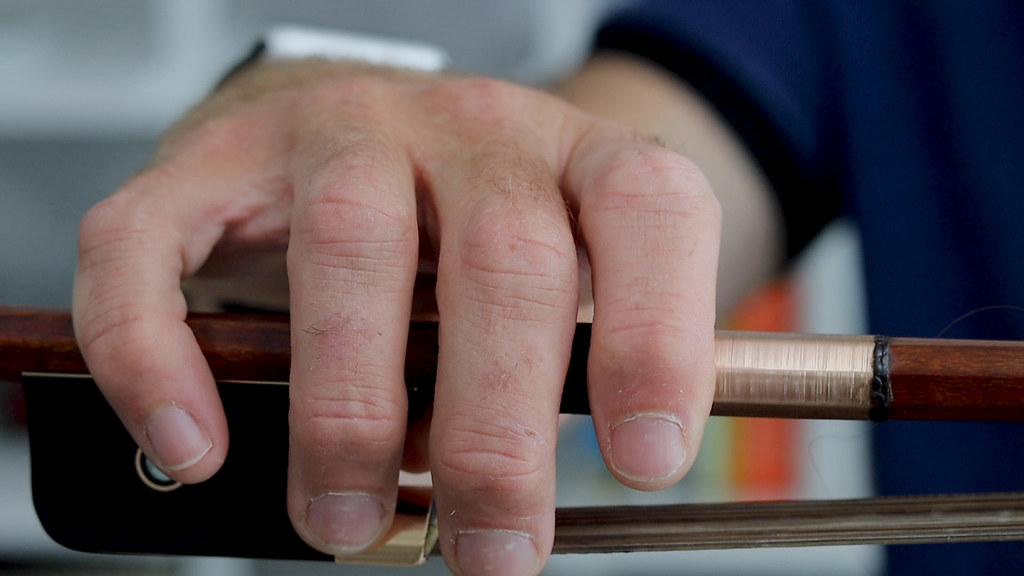
French bow hold
- Take your right manus and plow it palm side upwardly.
- Property the bow in your left paw past the bow screw, lay it into your fingers, with the bow pointing out and abroad from your body at a 45 degree angle. Your starting time finger should be on the bow grip, your 2nd and third fingers should residuum on or well-nigh the ferrule depending on your hand size, and the tip of your pinky should residuum on the "dot" on your frog.
- Have your thumb and rest it either confronting the place where the frog and stick other bow come across (professional person bow hold), or on the metal ferrule (early on bow hold)
- Flip the bow to your left and let the hair balance on one of the strings of your bass


German language bow hold
I've got an excellent set of slides from Olympia School District orchestra teacher Joe Dyvig. Joe passed these along to me for a dispensary a couple of years ago, and I've used them several times for contempo clinics!
Here are Joe's steps in list form:
- Agree your right arm up in the air, with your right hand dangling downwardly, like a zombie in a classic horror flick.
- Concur the German bow in your left hand, with the frog indicate toward the ceiling.
- Bring the German bow into your hand. Your pollex should rest lightly on the peak of the stick, your first finger should be on the octagonal side but outside of the i your thumb is on (easier to demonstrate than describe!), your 2nd finger should be on the lower outer octagonal side, resting confronting this and the edge of the frog, your third finger should be fairly free merely not crimper into the frog, and the tip of your fourth dinger should residual on the ferrule
- Bring the bow to the string.
Though the French and German bow holds look different, they both have a lot in common. Like so many things in life, there are countless variations on the basics accident holds I'm describing. What's I'm showing you has worked for my students, only in that location are a lot of other ways to approach both bow holds, so leave a annotate if yous've got a different approach!
You want to practise establishing your bow concur multiple times a day, and you desire to exist hyper-vigilant about staying relaxed and also maintaining these contact points.
As you start you lot get better, you'll realize that, like an expert chef or tennis player, at that place are a ton of slight variations within this basic bow hold, and you may change your arroyo slightly depending on what kind of musical requirements a piece has.
Getting your basic bow hold established and ingrained in your muscle memory is key for making progress. Utilise a mirror and really geek out on all these fiddling details. You'll be glad that you did so down the road!
Bow games
Nosotros desire our bow to feel similar a natural extension of our arm, and a proficient fashion to develop this is to practice a few "bow games." These may seem a little goofy at beginning, only they'll get a long way toward developing condolement and ease with the bow.
Hither are a few of my favorites, and there are a skillful fifteen-twenty others that I use occasionally with students:
1 – Stir the pot – With the bow tip pointing straight up, imagine that you're stirring a big cauldron and that your bow is a giant spoon. Brand big circles, small circles, and everything in betwixt. This is neat for developing flexibility and comfort, and also for agreement how the shoulder works when bowing.


two – Cast the line-fishing lure – Pretend that your bow is a fishing pole and that y'all're sending that finishing lure out over the water. Bring that bow back and ship that imaginary lure out in front of you, beingness conscientious to not drib the bow, of grade! This is great for developing the "finishing stroke" needed to complete a down bow.


three – Windshield wipers – This ane is simple. Point the bow direct upward in the air, then flip it to the left, correct, left, right, etc. This is great for developing forearm motion and understanding how torque works in bowing.
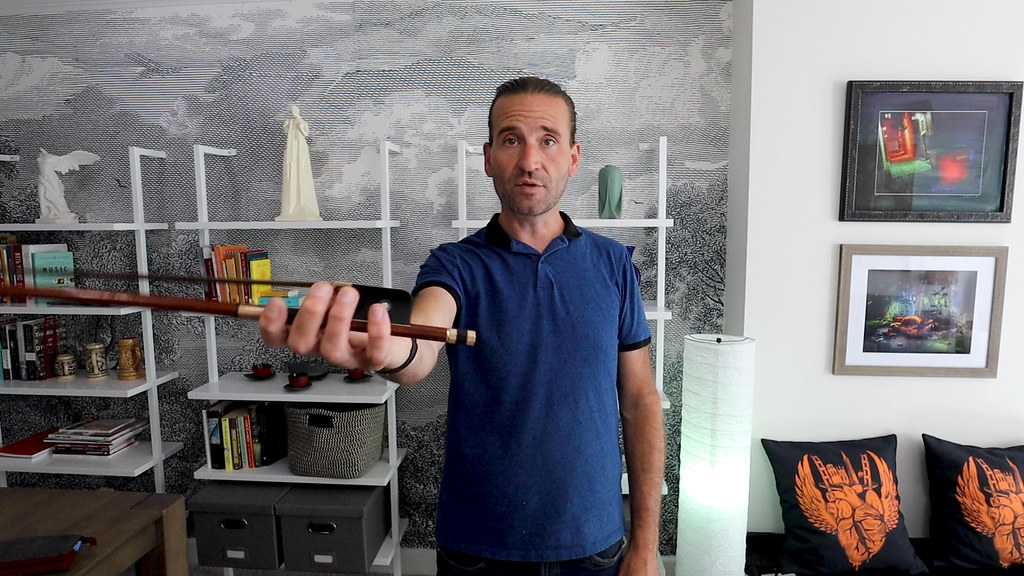

1 cautionary note about bow games: we don't want to practice our bow hold in playing position (with the stick parallel to the floor) without it resting on the string. We never actually need to hold the bow in the air similar this—it's always going to exist supported past the string.
While bow games are awesome for developing force and comfort, we want to exist careful that we're not belongings it horizontal or we risk developing tension and all kinds of strange bad habits.
Last footstep before bowing the bass
Now nosotros're going to… pluck the bass.
I know, you're itching to make a sound with the bow, but trust me, nosotros're almost there, and we've got a new exercise to get the weight into the string so that nosotros can get a proficient sound.
Splat
Think back to that frisbee exercise.
Nosotros're going to have the same principles, simply we're going to apply it the other direction at present.
With your bass in hand just without your bow, follow these steps:
- Let your right arm dangle by your side.
- Using your torso and shoulder to initiate the motility, bring your right hand upward over the fingerboard and "splat" your hand against the strings.
- Experience the weight of your arm sinking into the fingerboard. Observe the latent powdery that you take when you engage the unabridged arm and torso.
- Using all of that arm weight, pluck the D string. Notice how open up and resonant the audio of your bass is, and also how wide and free the vibrating string is. This is what we seek to emulate when bowing.


Making a sound with the bow
OK—it's bow time! With bass and bow in hand, follow these steps:
- Do everything in our pizzicato splat practise, but with the bow in hand, landing on the D string. You desire to hear a satisfying "click" when the bow lands on the string. Try to country with the hair flat against the string or with the pasty slightly angled toward you.
- If your bow bounces around on the cord, that's a sign that yous're non releasing all your weight into the string. With German bow, you may demand to modify your bow hair angle slightly more than so that you lot're not playing with entirely flat hair. Do the motility until it feels pretty much similar the motion yous did when playing pizzicato.
- With all that weight loaded onto the string, try fluctuant the string back and forth. It's nigh similar the bow is a behemothic sticky finger that'south holding onto the string.
- Pull the string slightly to the right, and then release the string and move the bow about one/four of its length to the right. This management is chosen downwards bow. Make sure that you're pulling the bow perpendicular to the cord at a xc degree angle. Using a mirror for this is super-helpful.
- If you lot grind yourself bowing another string in addition to D, don't worry—this is normal. In fact, bowing ii strings is actually a technique you lot'll use in the future chosen double stops. Notice if you lot're hitting the Yard string or A string in addition to the D string, and adjust your bending appropriately.
- Exercise this sequence several times: splat, engage, release. When you're comfortable, move on to the next footstep.
- Now do the aforementioned matter, but later on going one/4 of the way out (down bow), you're going to come dorsum to where your started. This direction is called upwards bow. You at present take two notes, one down bow and one up bow.
- When you're comfortable with that set up of two notes, endeavour stringing together four notes, then 6, eight, and as many as you tin can practise. Stay in that lower function of the bow for now.


Top 3 bow pitfalls to expect out for
Like many things in life, bowing is kind of simple only also quite challenging to chief.
Hither are the three about common mistakes and what you lot can do to fix them:
- Non using a straight bow – This is why using a mirror when practicing is and then helpful. Make sure that you're always at a 90 degree angle from the string. Without doing so, your whole technical foundation will be on shaky basis. Yous just accept too be vigilant and always checking in with yourself near information technology.
- Non fully engaging the cord – Information technology'south and so easy to let this i slide. Exist totally focused on getting the cardinal out of the cord. Unlike the other bowed string instruments, it's really easy to not fully engage the string and to skate across with a wispy sound. Always go on going dorsum to that splat exercise with your arm, plucking the string and besides splatting with the bow.
- Holding tension – Bass takes strength, and it'southward common for beginners to try to strength things rather than using their natural body and arm weight. Always be going dorsum to those away-from-bass exercises and bow games, and transferring that learning over to the bow.
Next steps
Hopefully this mail service has got you lot upward and running with making some basic open string sounds. I've taken everything covered here and put it into a PDF for your reference, and you can as well check out the accompanying video with musical examples and shut-ups of the mechanics and principles described here.
Manifestly, this is the tip of the iceberg when information technology comes to bowing, and you're probably wondering where to go adjacent.
I've got a bunch of resource located at contrabassconversations.com/teaching, and I've also got all ane octave major scales on YouTube for yous to play along with.
I've also got a beginner double bass class coming presently with the wonderful company Discover Double Bass, and if y'all'd like to exist notified when that'southward getting fix to launch, download this guide and I'll be sure to add together you to the listing!
Also, there are a ton of other resources online for taking your bowing to the next level. Here are some of my favorites:
- Bowing Technique Lessons for Double Bassists from Observe Double Bass
- Incredibly Useful Exercises for Double Bass past Dennis Whittaker
- French Bow Technique with Thomas Martin
- German Bow Technique with Thomas Martin
Thanks over again for joining me here, and let me know what else you lot'd like me to cover in terms of bowing!
Bass News Correct To Your Inbox!
Subscribe to get our weekly newsletter roofing the double bass earth.
Success! At present check your electronic mail to confirm your subscription.
Source: https://doublebassblog.org/2020/05/how-to-bow-a-double-bass.html
0 Response to "Bow Bass Break Here We Go Again"
Post a Comment