Can You Use a Va Loan to Buy a Manufactured Home
A mortgage loan or simply mortgage () is a loan used either past purchasers of real property to enhance funds to buy real manor, or past existing property owners to raise funds for any purpose while putting a lien on the holding being mortgaged. The loan is "secured" on the borrower's belongings through a procedure known as mortgage origination. This ways that a legal machinery is put into place which allows the lender to take possession and sell the secured property ("foreclosure" or "repossession") to pay off the loan in the issue the borrower defaults on the loan or otherwise fails to bide by its terms. The word mortgage is derived from a Law French term used in Great britain in the Middle Ages meaning "death pledge" and refers to the pledge ending (dying) when either the obligation is fulfilled or the belongings is taken through foreclosure.[1] A mortgage tin too be described as "a borrower giving consideration in the form of a collateral for a do good (loan)".
Mortgage borrowers tin be individuals mortgaging their home or they can exist businesses mortgaging commercial holding (for example, their ain business organization premises, residential property let to tenants, or an investment portfolio). The lender volition typically exist a fiscal establishment, such as a bank, credit union or edifice society, depending on the state concerned, and the loan arrangements can be made either directly or indirectly through intermediaries. Features of mortgage loans such as the size of the loan, maturity of the loan, interest charge per unit, method of paying off the loan, and other characteristics tin vary considerably. The lender'due south rights over the secured belongings take priority over the borrower's other creditors, which ways that if the borrower becomes bankrupt or insolvent, the other creditors will only be repaid the debts owed to them from a sale of the secured property if the mortgage lender is repaid in full outset.
In many jurisdictions, it is normal for habitation purchases to be funded by a mortgage loan. Few individuals have enough savings or liquid funds to enable them to buy property outright. In countries where the demand for dwelling ownership is highest, strong domestic markets for mortgages have developed. Mortgages can either be funded through the banking sector (that is, through curt-term deposits) or through the capital letter markets through a procedure called "securitization", which converts pools of mortgages into fungible bonds that can be sold to investors in small denominations.

Mortgage Loan. Total Payment (3 Fixed Interest Rates & 2 Loan Term) = Loan Principal + Expenses (Taxes & fees) + Full interest to be paid.
The final toll will exist exactly the aforementioned:
* when the interest rate is 2.five% and the term is 30 years than when the interest rate is 5% and the term is 15 years * when the involvement charge per unit is 5% and the term is 30 years than when the interest rate is 10% and the term is 15 years
Mortgage loan basics
Basic concepts and legal regulation
According to Anglo-American property law, a mortgage occurs when an owner (usually of a fee uncomplicated interest in realty) pledges his or her interest (right to the holding) equally security or collateral for a loan. Therefore, a mortgage is an encumbrance (limitation) on the right to the belongings merely every bit an easement would be, only because most mortgages occur as a status for new loan money, the discussion mortgage has get the generic term for a loan secured past such real property. Equally with other types of loans, mortgages have an interest rate and are scheduled to amortize over a set up period of fourth dimension, typically thirty years. All types of real holding tin exist, and usually are, secured with a mortgage and conduct an interest rate that is supposed to reverberate the lender's adventure.
Mortgage lending is the principal machinery used in many countries to finance private ownership of residential and commercial holding (see commercial mortgages). Although the terminology and precise forms will differ from state to country, the basic components tend to exist similar:
- Property: the physical residence being financed. The verbal form of ownership will vary from country to land and may restrict the types of lending that are possible.
- Mortgage: the security interest of the lender in the property, which may entail restrictions on the use or disposal of the property. Restrictions may include requirements to purchase home insurance and mortgage insurance, or pay off outstanding debt before selling the belongings.
- Borrower: the person borrowing who either has or is creating an ownership interest in the property.
- Lender: any lender, but usually a depository financial institution or other fiscal establishment. (In some countries, particularly the United states of america, Lenders may also be investors who ain an involvement in the mortgage through a mortgage-backed security. In such a situation, the initial lender is known as the mortgage originator, which and then packages and sells the loan to investors. The payments from the borrower are thereafter collected by a loan servicer.[2])
- Principal: the original size of the loan, which may or may not include certain other costs; as any principal is repaid, the principal volition go downwards in size.
- Interest: a fiscal charge for use of the lender's money.
- Foreclosure or repossession: the possibility that the lender has to foreclose, repossess or seize the property under sure circumstances is essential to a mortgage loan; without this aspect, the loan is arguably no dissimilar from any other type of loan.
- Completion: legal completion of the mortgage human action, and hence the starting time of the mortgage.
- Redemption: last repayment of the amount outstanding, which may be a "natural redemption" at the end of the scheduled term or a lump sum redemption, typically when the borrower decides to sell the property. A closed mortgage account is said to exist "redeemed".
Many other specific characteristics are common to many markets, but the to a higher place are the essential features. Governments usually regulate many aspects of mortgage lending, either direct (through legal requirements, for example) or indirectly (through regulation of the participants or the financial markets, such as the cyberbanking industry), and often through state intervention (direct lending by the government, direct lending by state-owned banks, or sponsorship of various entities). Other aspects that ascertain a specific mortgage market may exist regional, historical, or driven by specific characteristics of the legal or financial system.
Mortgage loans are mostly structured as long-term loans, the periodic payments for which are like to an annuity and calculated according to the time value of money formulae. The most basic system would require a fixed monthly payment over a menstruum of ten to xxx years, depending on local conditions. Over this catamenia the primary component of the loan (the original loan) would be slowly paid down through amortization. In exercise, many variants are possible and mutual worldwide and inside each land.
Lenders provide funds against belongings to earn involvement income, and generally borrow these funds themselves (for example, by taking deposits or issuing bonds). The price at which the lenders infringe money, therefore, affects the cost of borrowing. Lenders may also, in many countries, sell the mortgage loan to other parties who are interested in receiving the stream of cash payments from the borrower, often in the grade of a security (past means of a securitization).
Mortgage lending will also take into business relationship the (perceived) riskiness of the mortgage loan, that is, the likelihood that the funds volition be repaid (usually considered a role of the creditworthiness of the borrower); that if they are non repaid, the lender will be able to foreclose on the existent estate assets; and the fiscal, interest rate risk and time delays that may be involved in sure circumstances.
Mortgage underwriting
During the mortgage loan blessing process, a mortgage loan underwriter verifies the financial information that the applicant has provided as to income, employment, credit history and the value of the home beingness purchased via an appraisal.[3] An appraisal may be ordered. The underwriting process may accept a few days to a few weeks. Sometimes the underwriting process takes so long that the provided financial statements need to be resubmitted so they are electric current.[four] Information technology is appropriate to maintain the same employment and non to apply or open up new credit during the underwriting procedure. Any changes fabricated in the bidder'south credit, employment, or financial data could event in the loan beingness denied.
Mortgage loan types
At that place are many types of mortgages used worldwide, but several factors broadly ascertain the characteristics of the mortgage. All of these may be subject to local regulation and legal requirements.
- Involvement: Involvement may be fixed for the life of the loan or variable, and change at certain pre-defined periods; the involvement rate can as well, of grade, exist higher or lower.
- Term: Mortgage loans mostly take a maximum term, that is, the number of years after which an amortizing loan will exist repaid. Some mortgage loans may accept no amortization, or require full repayment of any remaining balance at a certain date, or even negative amortization.
- Payment amount and frequency: The amount paid per catamenia and the frequency of payments; in some cases, the amount paid per menstruum may modify or the borrower may have the choice to increase or decrease the amount paid.
- Prepayment: Some types of mortgages may limit or restrict prepayment of all or a portion of the loan, or require payment of a penalization to the lender for prepayment.
The two basic types of amortized loans are the fixed rate mortgage (FRM) and adaptable-rate mortgage (ARM) (likewise known as a floating rate or variable charge per unit mortgage). In some countries, such as the United States, fixed rate mortgages are the norm, but floating rate mortgages are relatively mutual. Combinations of fixed and floating rate mortgages are also common, whereby a mortgage loan will accept a fixed rate for some period, for case the first five years, and vary subsequently the end of that period.
- In a fixed-rate mortgage, the interest charge per unit, remains fixed for the life (or term) of the loan. In the case of an annuity repayment scheme, the periodic payment remains the same corporeality throughout the loan. In the instance of linear payback, the periodic payment will gradually decrease.
- In an adjustable-rate mortgage, the involvement rate is mostly fixed for a period of time, subsequently which it will periodically (for example, annually or monthly) adjust up or down to some market index. Adaptable rates transfer part of the interest rate risk from the lender to the borrower and thus are widely used where fixed rate funding is difficult to obtain or prohibitively expensive. Since the risk is transferred to the borrower, the initial interest charge per unit may be, for case, 0.v% to 2% lower than the average 30-year fixed rate; the size of the price differential will be related to debt market conditions, including the yield curve.
The charge to the borrower depends upon the credit risk in addition to the interest rate risk. The mortgage origination and underwriting process involves checking credit scores, debt-to-income, downpayments, assets, and assessing holding value. Jumbo mortgages and subprime lending are not supported past authorities guarantees and face higher involvement rates. Other innovations described below tin can affect the rates as well.
Loan to value and down payments
Upon making a mortgage loan for the purchase of a holding, lenders ordinarily require that the borrower brand a downwardly payment; that is, contribute a portion of the price of the holding. This down payment may be expressed every bit a portion of the value of the property (see beneath for a definition of this term). The loan to value ratio (or LTV) is the size of the loan confronting the value of the property. Therefore, a mortgage loan in which the purchaser has made a downward payment of 20% has a loan to value ratio of eighty%. For loans fabricated against backdrop that the borrower already owns, the loan to value ratio will be imputed against the estimated value of the property.
The loan to value ratio is considered an important indicator of the riskiness of a mortgage loan: the higher the LTV, the higher the risk that the value of the holding (in example of foreclosure) will exist insufficient to cover the remaining principal of the loan.
Value: appraised, estimated, and bodily
Since the value of the property is an important factor in understanding the risk of the loan, determining the value is a cardinal cistron in mortgage lending. The value may be determined in various ways, only the most common are:
- Actual or transaction value: this is unremarkably taken to be the purchase price of the holding. If the belongings is not being purchased at the time of borrowing, this information may not exist bachelor.
- Appraised or surveyed value: in most jurisdictions, some course of appraisal of the value past a licensed professional is common. In that location is ofttimes a requirement for the lender to obtain an official appraisal.
- Estimated value: lenders or other parties may use their own internal estimates, particularly in jurisdictions where no official appraisement procedure exists, but likewise in some other circumstances.
Payment and debt ratios
In most countries, a number of more or less standard measures of creditworthiness may be used. Common measures include payment to income (mortgage payments equally a pct of gross or net income); debt to income (all debt payments, including mortgage payments, as a percent of income); and various net worth measures. In many countries, credit scores are used in lieu of or to supplement these measures. In that location volition also be requirements for documentation of the creditworthiness, such equally income tax returns, pay stubs, etc. the specifics will vary from location to location. Income tax incentives usually can be practical in forms of revenue enhancement refunds or tax deduction schemes. The offset implies that income tax paid by individual taxpayers will be refunded to the extent of interest on mortgage loans taken to acquire residential property. Income taxation deduction implies lowering tax liability to the extent of interest rate paid for the mortgage loan.
Some lenders may too require a potential borrower have one or more months of "reserve assets" available. In other words, the borrower may be required to bear witness the availability of enough assets to pay for the housing costs (including mortgage, taxes, etc.) for a period of time in the event of the job loss or other loss of income.
Many countries have lower requirements for certain borrowers, or "no-medico" / "low-dr." lending standards that may be acceptable under certain circumstances.
Standard or conforming mortgages
Many countries take a notion of standard or conforming mortgages that ascertain a perceived acceptable level of risk, which may be formal or informal, and may be reinforced by laws, regime intervention, or market practice. For example, a standard mortgage may be considered to be i with no more than 70–80% LTV and no more than one-tertiary of gross income going to mortgage debt.
A standard or conforming mortgage is a key concept every bit it frequently defines whether or not the mortgage can be easily sold or securitized, or, if non-standard, may touch the price at which it may be sold. In the United States, a conforming mortgage is ane which meets the established rules and procedures of the 2 major government-sponsored entities in the housing finance market (including some legal requirements). In contrast, lenders who make up one's mind to make nonconforming loans are exercising a higher risk tolerance and do so knowing that they face more than claiming in reselling the loan. Many countries have similar concepts or agencies that ascertain what are "standard" mortgages. Regulated lenders (such as banks) may be subject to limits or higher-risk weightings for non-standard mortgages. For example, banks and mortgage brokerages in Canada face restrictions on lending more than 80% of the property value; beyond this level, mortgage insurance is by and large required.[5]
Foreign currency mortgage
In some countries with currencies that tend to depreciate, foreign currency mortgages are common, enabling lenders to lend in a stable foreign currency, whilst the borrower takes on the currency risk that the currency will depreciate and they will therefore need to convert higher amounts of the domestic currency to repay the loan.
Repaying the mortgage
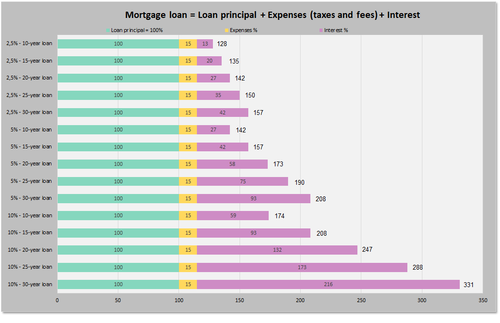
Mortgage Loan. Total Payment = Loan Principal + Expenses (Taxes & fees) + Total interests. Stock-still Interest Rates & Loan Term
In addition to the ii standard means of setting the cost of a mortgage loan (fixed at a set interest rate for the term, or variable relative to marketplace involvement rates), at that place are variations in how that price is paid, and how the loan itself is repaid. Repayment depends on locality, tax laws and prevailing culture. There are also various mortgage repayment structures to arrange different types of borrower.
Principal and interest
The nearly common style to repay a secured mortgage loan is to make regular payments toward the principal and interest over a set up term.[ citation needed ] This is commonly referred to equally (self) amortization in the U.S. and every bit a repayment mortgage in the Uk. A mortgage is a class of annuity (from the perspective of the lender), and the calculation of the periodic payments is based on the time value of money formulas. Sure details may be specific to different locations: interest may be calculated on the basis of a 360-day year, for example; interest may exist compounded daily, yearly, or semi-annually; prepayment penalties may apply; and other factors. In that location may be legal restrictions on sure matters, and consumer protection laws may specify or prohibit certain practices.
Depending on the size of the loan and the prevailing do in the land the term may exist brusk (10 years) or long (l years plus). In the UK and U.S., 25 to xxx years is the usual maximum term (although shorter periods, such as xv-year mortgage loans, are common). Mortgage payments, which are typically made monthly, incorporate a repayment of the primary and an interest element. The amount going toward the main in each payment varies throughout the term of the mortgage. In the early on years the repayments are mostly interest. Towards the finish of the mortgage, payments are mostly for primary. In this way, the payment amount adamant at outset is calculated to ensure the loan is repaid at a specified engagement in the futurity. This gives borrowers assurance that by maintaining repayment the loan volition be cleared at a specified date if the involvement rate does non change. Some lenders and 3rd parties offering a bi-weekly mortgage payment programme designed to accelerate the payoff of the loan. Similarly, a mortgage can be ended before its scheduled end by paying some or all of the remainder prematurely, called curtailment.[6]
An amortization schedule is typically worked out taking the primary left at the cease of each calendar month, multiplying by the monthly rate and and then subtracting the monthly payment. This is typically generated past an amortization calculator using the following formula:
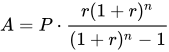
where:
- is the periodic amortization payment
- is the principal amount borrowed
- is the rate of interest expressed equally a fraction; for a monthly payment, take the (Annual Rate)/12
- is the number of payments; for monthly payments over 30 years, 12 months x thirty years = 360 payments.


Interest only
The chief alternative to a principal and involvement mortgage is an interest-only mortgage, where the principal is non repaid throughout the term. This type of mortgage is common in the UK, particularly when associated with a regular investment programme. With this system regular contributions are fabricated to a separate investment plan designed to build upward a lump sum to repay the mortgage at maturity. This type of arrangement is called an investment-backed mortgage or is oft related to the type of programme used: endowment mortgage if an endowment policy is used, similarly a personal equity plan (PEP) mortgage, Individual Savings Business relationship (ISA) mortgage or pension mortgage. Historically, investment-backed mortgages offered diverse tax advantages over repayment mortgages, although this is no longer the instance in the UK. Investment-backed mortgages are seen as higher chance as they are dependent on the investment making sufficient return to articulate the debt.
Until recently[ when? ] information technology was non uncommon for interest only mortgages to exist bundled without a repayment vehicle, with the borrower gambling that the property market will rise sufficiently for the loan to be repaid by trading downward at retirement (or when rent on the property and inflation combine to surpass the interest rate)[ citation needed ].
Interest-simply lifetime mortgage
Recent Financial Services Authority guidelines to Great britain lenders regarding interest-simply mortgages has tightened the criteria on new lending on an interest-only ground. The problem for many people has been the fact that no repayment vehicle had been implemented, or the vehicle itself (due east.g. endowment/ISA policy) performed poorly and therefore bereft funds were available to repay residue at the finish of the term.
Moving forward, the FSA under the Mortgage Marketplace Review (MMR) have stated there must exist strict criteria on the repayment vehicle being used. As such the likes of Nationwide and other lenders take pulled out of the interest-simply market.
A resurgence in the disinterestedness release market has been the introduction of interest-simply lifetime mortgages. Where an interest-only mortgage has a fixed term, an involvement-just lifetime mortgage will continue for the rest of the mortgagors life. These schemes accept proved of interest to people who do like the scroll-up effect (compounding) of interest on traditional equity release schemes. They have likewise proved beneficial to people who had an interest-simply mortgage with no repayment vehicle and now need to settle the loan. These people can now effectively remortgage onto an interest-only lifetime mortgage to maintain continuity.
Interest-but lifetime mortgage schemes are currently offered by two lenders – Stonehaven and more2life. They work by having the options of paying the interest on a monthly basis. By paying off the interest means the balance volition remain level for the rest of their life. This market is set to increase equally more retirees require finance in retirement.
Opposite mortgages
For older borrowers (typically in retirement), it may be possible to adapt a mortgage where neither the principal nor interest is repaid. The interest is rolled up with the primary, increasing the debt each yr.
These arrangements are variously called contrary mortgages, lifetime mortgages or equity release mortgages (referring to abode equity), depending on the country. The loans are typically not repaid until the borrowers are deceased, hence the age restriction.
Through the Federal Housing Administration, the U.S. authorities insures reverse mortgages via a programme called the HECM (Home Equity Conversion Mortgage). Unlike standard mortgages (where the entire loan amount is typically disbursed at the time of loan closing) the HECM program allows the homeowner to receive funds in a variety of ways: as a one time lump sum payment; every bit a monthly tenure payment which continues until the borrower dies or moves out of the firm permanently; as a monthly payment over a defined menses of time; or as a credit line.[seven]
For farther details, run across equity release.
Interest and partial principal
In the U.S. a fractional acquittal or balloon loan is one where the corporeality of monthly payments due are calculated (amortized) over a certain term, but the outstanding balance on the principal is due at some point short of that term. In the UK, a partial repayment mortgage is quite common, especially where the original mortgage was investment-backed.
Variations
Graduated payment mortgage loans have increasing costs over time and are geared to young borrowers who expect wage increases over time. Balloon payment mortgages take only partial amortization, meaning that amount of monthly payments due are calculated (amortized) over a sure term, just the outstanding principal rest is due at some bespeak curt of that term, and at the cease of the term a balloon payment is due. When interest rates are loftier relative to the rate on an existing seller'due south loan, the buyer can consider assuming the seller's mortgage.[8] A wraparound mortgage is a grade of seller financing that can make it easier for a seller to sell a property. A biweekly mortgage has payments made every two weeks instead of monthly.
Upkeep loans include taxes and insurance in the mortgage payment;[9] package loans add the costs of effects and other personal belongings to the mortgage. Buydown mortgages permit the seller or lender to pay something like to points to reduce interest charge per unit and encourage buyers.[10] Homeowners can also take out equity loans in which they receive cash for a mortgage debt on their house. Shared appreciation mortgages are a course of disinterestedness release. In the U.s., foreign nationals due to their unique situation face Foreign National mortgage weather condition.
Flexible mortgages let for more liberty by the borrower to skip payments or prepay. First mortgages allow deposits to be counted against the mortgage loan. In the Britain at that place is also the endowment mortgage where the borrowers pay interest while the principal is paid with a life insurance policy.
Commercial mortgages typically have different interest rates, risks, and contracts than personal loans. Participation mortgages allow multiple investors to share in a loan. Builders may take out blanket loans which embrace several properties at once. Bridge loans may be used as temporary financing awaiting a longer-term loan. Hard coin loans provide financing in commutation for the mortgaging of real manor collateral.
Foreclosure and non-recourse lending
In most jurisdictions, a lender may foreclose the mortgaged belongings if certain weather occur – principally, non-payment of the mortgage loan. Subject to local legal requirements, the property may then exist sold. Whatever amounts received from the sale (internet of costs) are applied to the original debt. In some jurisdictions, mortgage loans are non-recourse loans: if the funds recouped from sale of the mortgaged holding are insufficient to cover the outstanding debt, the lender may non have recourse to the borrower afterwards foreclosure. In other jurisdictions, the borrower remains responsible for whatsoever remaining debt.
In well-nigh all jurisdictions, specific procedures for foreclosure and sale of the mortgaged property apply, and may exist tightly regulated by the relevant authorities. In that location are strict or judicial foreclosures and non-judicial foreclosures, also known as ability of sale foreclosures. In some jurisdictions, foreclosure and sale can occur quite quickly, while in others, foreclosure may have many months or even years. In many countries, the ability of lenders to forestall is extremely limited, and mortgage market development has been notably slower.
National differences
A study issued by the United nations Economic Commission for Europe compared German, Usa, and Danish mortgage systems. The German Bausparkassen take reported nominal involvement rates of approximately 6 per cent per annum in the last 40 years (as of 2004). German Bausparkassen (savings and loans associations) are not identical with banks that give mortgages. In addition, they charge assistants and service fees (about ane.5 per cent of the loan amount). Yet, in the United states of america, the average interest rates for fixed-charge per unit mortgages in the housing marketplace started in the tens and twenties in the 1980s and have (every bit of 2004) reached about 6 per cent per annum. Nevertheless, gross borrowing costs are essentially higher than the nominal interest rate and amounted for the last 30 years to 10.46 per cent. In Denmark, like to the U.s.a. mortgage market, interest rates have fallen to 6 per cent per annum. A risk and administration fee amounts to 0.5 per cent of the outstanding debt. In addition, an acquisition fee is charged which amounts to one per cent of the chief.[11]
United States
The mortgage manufacture of the United States is a major financial sector. The federal regime created several programs, or government sponsored entities, to foster mortgage lending, construction and encourage abode ownership. These programs include the Government National Mortgage Association (known as Ginnie Mae), the Federal National Mortgage Association (known equally Fannie Mae) and the Federal Dwelling house Loan Mortgage Corporation (known as Freddie Mac).
The U.s.a. mortgage sector has been the center of major financial crises over the terminal century. Unsound lending practices resulted in the National Mortgage Crisis of the 1930s, the savings and loan crisis of the 1980s and 1990s and the subprime mortgage crunch of 2007 which led to the 2010 foreclosure crisis.
In the United States, the mortgage loan involves two separate documents: the mortgage note (a promissory note) and the security interest evidenced by the "mortgage" document; generally, the two are assigned together, only if they are split traditionally the holder of the annotation and not the mortgage has the right to forestall.[12] For instance, Fannie Mae promulgates a standard form contract Multistate Fixed-Rate Notation 3200[13] and also split security instrument mortgage forms which vary by state.[14]
History in the United States
The idea of purchasing country is a relatively new idea. The idea of credit being used to purchase state originated with the British colonies in the future United States. The colonists did not give indigenous people already living in America any coin for the land they took from them. This was not the but shocking difference betwixt pre-colonized America and post-colonized America. There were huge environmental and biological changes, which led to social, economic, and political changes. In that location was new types of violence and diseases brought to America. The colonists traded with "wampum,"[xv] which was a string of shell beads in different colors and shells. White ones were called wompi, black ones were called sucka uhock. Round clams were worth twice as much as the white wompi shells. They were around 1-8th of an inch in diameter and one-quarter inch in length. Colonists attempted to trade with ethnic people for skins by growing corn. But corn could not become the colonists the best skins, such as beaver skins. The shells were called to be used equally money considering of the symbolic significant they held for the tribes. Ethnic people believed the shells came from a blazon of God.[xv] The shells could even be talked into to proceed words and stories. On the colonists' side, in that location was besides a significance that the indigenous people did not understand. Colonists from England actively pursued trade with the indigenous people, and adopted their ideas for trade. The English originally were surprised to run across that people did not automatically follow the trading customs of England. As more and more colonists came to America, the indigenous people lost some of their power. They began to stockpile goods that they knew the colonists would desire to keep their ability in the trade. Every bit colonists expanded into new spaces, the power dynamic got worse for the indigenous people.[fifteen] The colonists began to exploit the differences betwixt the groups of how important sure goods were. They created debt around the idea of purchasing land. William Pynchon, a settler in what is currently Connecticut, used wampum to gain an advantage in the fur merchandise. He gave out credit to settlers who helped him create wampum. Afterwards a while of the settlers being in the Usa, land became its own kind of coin. This assisted the colonists in taking the land from the indigenous people.[15]
Canada
In Canada, the Canada Mortgage and Housing Corporation (CMHC) is the state's national housing agency, providing mortgage loan insurance, mortgage-backed securities, housing policy and programs, and housing enquiry to Canadians.[16] It was created by the federal regime in 1946 to address the country'due south postal service-state of war housing shortage, and to help Canadians achieve their homeownership goals.
The most mutual mortgage in Canada is the v-year stock-still-rate closed mortgage, as opposed to the U.South. where the most mutual blazon is the xxx-twelvemonth stock-still-rate open mortgage.[17] Throughout the financial crisis and the ensuing recession, Canada's mortgage market place continued to part well, partly due to the residential mortgage market'south policy framework, which includes an effective regulatory and supervisory government that applies to almost lenders. Since the crunch, nevertheless, the low interest rate environment that has arisen has contributed to a significant increase in mortgage debt in the country.[18]
In April 2014, the Role of the Superintendent of Fiscal Institutions (OSFI) released guidelines for mortgage insurance providers aimed at tightening standards around underwriting and risk management. In a argument, the OSFI has stated that the guideline will "provide clarity about best practices in respect of residential mortgage insurance underwriting, which contribute to a stable financial system." This comes subsequently several years of federal government scrutiny over the CMHC, with former Finance Minister Jim Flaherty musing publicly as far back every bit 2022 nigh privatizing the Crown corporation.[nineteen]
In an try to cool downwards the real estate prices in Canada, Ottawa introduced a mortgage stress test constructive 17 October 2016.[20] Nether the stress exam, every domicile heir-apparent who wants to get a mortgage from any federally regulated lender should undergo a exam in which the borrower's affordability is judged based on a rate that is not lower than a stress rate ready by the Bank of Canada. For high-ratio mortgage (loan to value of more than 80%), which is insured by Canada Mortgage and Housing Corporation, the rate is the maximum of the stress test rate and the current target rate. Notwithstanding, for uninsured mortgage, the rate is the maximum of the stress exam rate and the target involvement rate plus 2%. [21] This stress test has lowered the maximum mortgage approved amount for all borrowers in Canada.
The stress-exam rate consistently increased until its peak of 5.34% in May 2022 and it was non inverse until July 2022 in which for the first time in three years it decreased to 5.19%.[22] This decision may reflect the push-back from the real-estate manufacture[23] as well as the introduction of the offset-time home buyer incentive programme (FTHBI) by the Canadian authorities in the 2022 Canadian federal upkeep. Considering of all the criticisms from real manor industry, Canada finance minister Nib Morneau ordered to review and consider changes to the mortgage stress test in December 2019.[24]
Britain
The mortgage industry of the United Kingdom has traditionally been dominated by building societies, but from the 1970s the share of the new mortgage loans market held by building societies has declined essentially. Betwixt 1977 and 1987, the share roughshod from 96% to 66% while that of banks and other institutions rose from iii% to 36%. At that place are currently over 200 significant split fiscal organizations supplying mortgage loans to house buyers in United kingdom of great britain and northern ireland. The major lenders include building societies, banks, specialized mortgage corporations, insurance companies, and pension funds.
In the U.k. variable-rate mortgages are more common than in the United States.[25] [26] This is in function considering mortgage loan financing relies less on fixed income securitized avails (such as mortgage-backed securities) than in the United States, Denmark, and Germany, and more than on retail savings deposits like Australia and Spain.[25] [26] Thus, lenders prefer variable-rate mortgages to fixed rate ones and whole-of-term fixed rate mortgages are generally not available. All the same, in recent years fixing the rate of the mortgage for short periods has get popular and the initial two, three, 5 and, occasionally, x years of a mortgage can be fixed.[27] From 2007 to the beginning of 2022 between 50% and 83% of new mortgages had initial periods fixed in this way.[28]
Home ownership rates are comparable to the Us, but overall default rates are lower.[25] Prepayment penalties during a fixed rate period are common, whilst the United States has discouraged their use.[25] Like other European countries and the rest of the world, just unlike most of the United States, mortgages loans are usually not nonrecourse debt, meaning debtors are liable for whatever loan deficiencies after foreclosure.[25] [29]
The client-facing aspects of the residential mortgage sector are regulated by the Financial Bear Authority (FCA), and lenders' financial probity is overseen past a separate regulator, the Prudential Regulation Authority (PRA) which is part of the Banking concern of England. The FCA and PRA were established in 2022 with the aim of responding to criticism of regulatory failings highlighted by the financial crisis of 2007–2008 and its backwash.[30] [31] [32]
Continental Europe
In about of Western Europe (except Denmark, the netherlands and Germany), variable-rate mortgages are more common, unlike the fixed-charge per unit mortgage common in the U.s.a..[25] [26] Much of Europe has abode ownership rates comparable to the United States, just overall default rates are lower in Europe than in the United States.[25] Mortgage loan financing relies less on securitizing mortgages and more on formal authorities guarantees backed past covered bonds (such as the Pfandbriefe) and deposits, except Denmark and Germany where asset-backed securities are also common.[25] [26] Prepayment penalties are nonetheless mutual, whilst the United states has discouraged their apply.[25] Unlike much of the United States, mortgage loans are unremarkably not nonrecourse debt.[25]
Within the European Union, covered bonds marketplace volume (covered bonds outstanding) amounted to about EUR 2 trillion at twelvemonth-end 2007 with Federal republic of germany, Denmark, Spain, and France each having outstandings in a higher place 200,000 EUR million.[33] Pfandbrief-like securities have been introduced in more than than 25 European countries—and in recent years also in the U.S. and other countries outside Europe—each with their ain unique police and regulations.[34]
Contempo trends
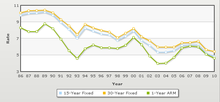
Mortgage rates historical trends 1986 to 2010
On July 28, 2008, US Treasury Secretary Henry Paulson announced that, along with four large U.S. banks, the Treasury would attempt to boot get-go a market for these securities in the United States, primarily to provide an alternative form of mortgage-backed securities.[35] Similarly, in the Uk "the Government is inviting views on options for a U.k. framework to deliver more affordable long-term fixed-rate mortgages, including the lessons to be learned from international markets and institutions".[36]
George Soros'due south October x, 2008 The Wall Street Journal editorial promoted the Danish mortgage market model.[37]
Malaysia
Mortgages in Malaysia can be categorised into 2 different groups: conventional dwelling house loan and Islamic abode loan. Under the conventional habitation loan, banks ordinarily charge a fixed interest rate, a variable interest rate, or both. These involvement rates are tied to a base rate (private depository financial institution's benchmark rate).
For Islamic habitation financing, it follows the Sharia Police force and comes in 2 common types: Bai' Bithaman Ajil (BBA) or Musharakah Mutanaqisah (MM). Bai' Bithaman Ajil is when the depository financial institution buys the property at electric current market price and sells it back to you at a much higher price. Musharakah Mutanaqisah is when the bank buys the property together with you. You will then slowly purchase the bank's portion of the belongings through rental (whereby a portion of the rental goes to paying for the buy of a part of the depository financial institution's share in the property until the property comes to your complete ownership).
Islamic countries
Islamic Sharia law prohibits the payment or receipt of interest, meaning that Muslims cannot utilise conventional mortgages. However, real estate is far too expensive for virtually people to buy outright using cash: Islamic mortgages solve this trouble by having the holding change hands twice. In one variation, the bank volition buy the firm outright and so deed as a landlord. The homebuyer, in addition to paying rent, will pay a contribution towards the purchase of the property. When the concluding payment is made, the belongings changes hands.[ description needed ]
Typically, this may lead to a higher final price for the buyers. This is because in some countries (such as the United Kingdom and Bharat) in that location is a stamp duty which is a tax charged by the government on a modify of ownership. Because ownership changes twice in an Islamic mortgage, a stamp tax may be charged twice. Many other jurisdictions accept similar transaction taxes on modify of ownership which may be levied. In the United Kingdom, the dual application of stamp duty in such transactions was removed in the Finance Deed 2003 in order to facilitate Islamic mortgages.[38]
An alternative scheme involves the bank reselling the holding co-ordinate to an installment plan, at a price higher than the original price.
Both of these methods recoup the lender every bit if they were charging involvement, merely the loans are structured in a way that in name they are not, and the lender shares the financial risks involved in the transaction with the homebuyer.[ citation needed ]
Mortgage insurance
Mortgage insurance is an insurance policy designed to protect the mortgagee (lender) from any default by the mortgagor (borrower). It is used commonly in loans with a loan-to-value ratio over 80%, and employed in the event of foreclosure and repossession.
This policy is typically paid for past the borrower as a component to final nominal (note) rate, or in one lump sum upward front, or as a split up and itemized component of monthly mortgage payment. In the last case, mortgage insurance can be dropped when the lender informs the borrower, or its subsequent assigns, that the holding has appreciated, the loan has been paid downwardly, or any combination of both to relegate the loan-to-value nether 80%.
In the upshot of repossession, banks, investors, etc. must resort to selling the property to recoup their original investment (the money lent) and are able to dispose of difficult assets (such every bit real estate) more than quickly by reductions in price. Therefore, the mortgage insurance acts equally a hedge should the repossessing potency recover less than total and fair market value for any difficult nugget.
See also
- Commercial mortgage
- Mortgage analytics
- No Income No Asset (NINA)
- Nonrecourse debt
- Refinancing
- Second Mortgage
- Buy to allow
- Mortgage cashback
- Remortgage
- United kingdom mortgage terminology
- Commercial lender (US) – a term for a lender collateralizing non-residential properties.
- eMortgages
- FHA loan – Relating to the U.South. Federal Housing Administration
- Stock-still charge per unit mortgage calculations (USA)
- Location Efficient Mortgage – a type of mortgage for urban areas
- Mortgage assumption
- pre-blessing – U.S. mortgage terminology
- pre-qualification – U.S. mortgage terminology
- Predatory mortgage lending
- VA loan – Relating to the U.S. Department of Veterans Affairs.
Other nations
- Danish mortgage market
- Hypothec - equivalent in ceremonious law countries
- Mortgage Investment Corporation
Legal details
- Human activity – legal aspects
- Mechanics lien – a legal concept
- Perfection – applicative legal filing requirements
References
- ^ Coke, Edward. Commentaries on the Laws of England.
[I]f he doth not pay, then the Land which is put in pledge upon status for the payment of the money, is taken from him for ever, and so dead to him upon condition, &c. And if he doth pay the money, then the pledge is dead equally to the Tenant
- ^ FTC. Mortgage Servicing: Making Sure Your Payments Count.
- ^ "How Long Does Mortgage Underwriting Have?". homeguides.sfgate.com. SFGate. Retrieved 9 December 2016.
- ^ "What Is an Underwriter: The Unseen Approver of Your Mortgage". 26 February 2014.
- ^ "Who Needs Mortgage Loan Insurance?". Canadian Mortgage and Housing Corporation. Retrieved 2009-01-thirty .
- ^ Bodine, Alicia (April 5, 2019). "Definition of Mortgage Curtailment". budgeting.thenest.com. Certified Ramsey Solutions Master Financial Double-decker (Updated).
- ^ "How do HECM Reverse Mortgages Work?". The Mortgage Professor.
- ^ Are Mortgage Assumptions a Skilful Bargain?. Mortgage Professor.
- ^ Cortesi GR. (2003). Mastering Real Estate Principals. p. 371
- ^ Homes: Slow-market savings – the 'buy-down'. CNN Coin.
- ^ http://world wide web.unece.org/hlm/prgm/hmm/hsg_finance/publications/housing.finance.system.pdf , p. 46
- ^ Renuart Eastward. (2012). Property Championship Trouble in Non-Judicial Foreclosure States: The Ibanez Time Bomb?. Albany Law School
- ^ Single-family notes. Fannie Mae.
- ^ Security Instruments. Fannie Mae.
- ^ a b c d Park, Sue (2016). "Coin, Mortgages, and the Conquest of America". Law & Social Research. 41 (4): 1006–1035. doi:ten.1111/lsi.12222. S2CID 157705999.
- ^ "About CMHC - CMHC". CMHC.
- ^ "Comparing Canada and U.Southward. Housing Finance Systems - CMHC". CMHC.
- ^ Crawford, Allan. "The Residential Mortgage Market place in Canada: A Primer" (PDF). bankofcanada.ca.
- ^ Greenwood, John (xiv April 2014). "New mortgage guidelines button CMHC to embrace insurance basics". Financial Post.
- ^ "New mortgage stress test rules kicking in today". CBC News. Retrieved eighteen March 2019.
- ^ "Mortgage Qualifier Tool". Authorities of Canada. eleven May 2012.
- ^ Evans, Pete (July 19, 2019). "Mortgage stress test rules become more than lenient for first time". CBC News . Retrieved October xxx, 2019.
- ^ Zochodne, Geoff (June 11, 2019). "Regulator defends mortgage stress test in face of push button-back from manufacture". Financial Postal service . Retrieved October 30, 2019.
- ^ Zochodne, Geoff (13 December 2019). "Finance government minister Nib Morneau to review and consider changes to mortgage stress test". Financial Post.
- ^ a b c d e f g h i j Congressional Budget Part (2010). Fannie Mae, Freddie Mac, and the Federal Office in the Secondary Mortgage Market place. p. 49.
- ^ a b c d International Budgetary Fund (2004). World Economic Outlook: September 2004: The Global Demographic Transition. pp. 81–83. ISBN978-i-58906-406-5.
- ^ "All-time fixed charge per unit mortgages: ii, three, v and 10 years". The Telegraph. 26 February 2014. Archived from the original on 2022-01-11. Retrieved x May 2014.
- ^ "Demand for fixed mortgages hits all-fourth dimension high". The Telegraph. 17 May 2013. Archived from the original on 2022-01-11. Retrieved ten May 2014.
- ^ United nations (2009). Forest Products Almanac Market Review 2008-2009. Un Publications. p. 42. ISBN978-92-1-117007-viii.
- ^ Vina, Gonzalo. "U.K. Scraps FSA in Biggest Banking concern Regulation Overhaul Since 1997". Businessweek. Bloomberg L.P. Retrieved 10 May 2014.
- ^ "Regulatory Reform Groundwork". FSA web site. FSA. Retrieved 10 May 2014.
- ^ "Financial Services Bill receives Royal Assent". HM Treasury. 19 December 2012. Retrieved 10 May 2014.
- ^ "Covered Bond Outstanding 2007".
- ^ "UNECE Homepage" (PDF). www.unece.org.
- ^ possessor, name of the document. "FDIC: Press Releases - PR-60-2008 seven/15/2008". www.fdic.gov.
- ^ "Housing Finance Review: analysis and proposals. HM Treasury, March 2008" (PDF).
- ^ Soros, George (10 October 2008). "Denmark Offers a Model Mortgage Marketplace". Wall Street Journal – via www.wsj.com.
- ^ "SDLTM28400 - Stamp Duty State Revenue enhancement Transmission - HMRC internal manual - GOV.UK". www.hmrc.gov.uk.
External links
- Mortgages at Curlie
- Mortgages: For Home Buyers and Homeowners at USA.gov
- Australian Securities & Investments Commission (ASIC) Home Loans
Source: https://en.wikipedia.org/wiki/Mortgage_loan
0 Response to "Can You Use a Va Loan to Buy a Manufactured Home"
Post a Comment